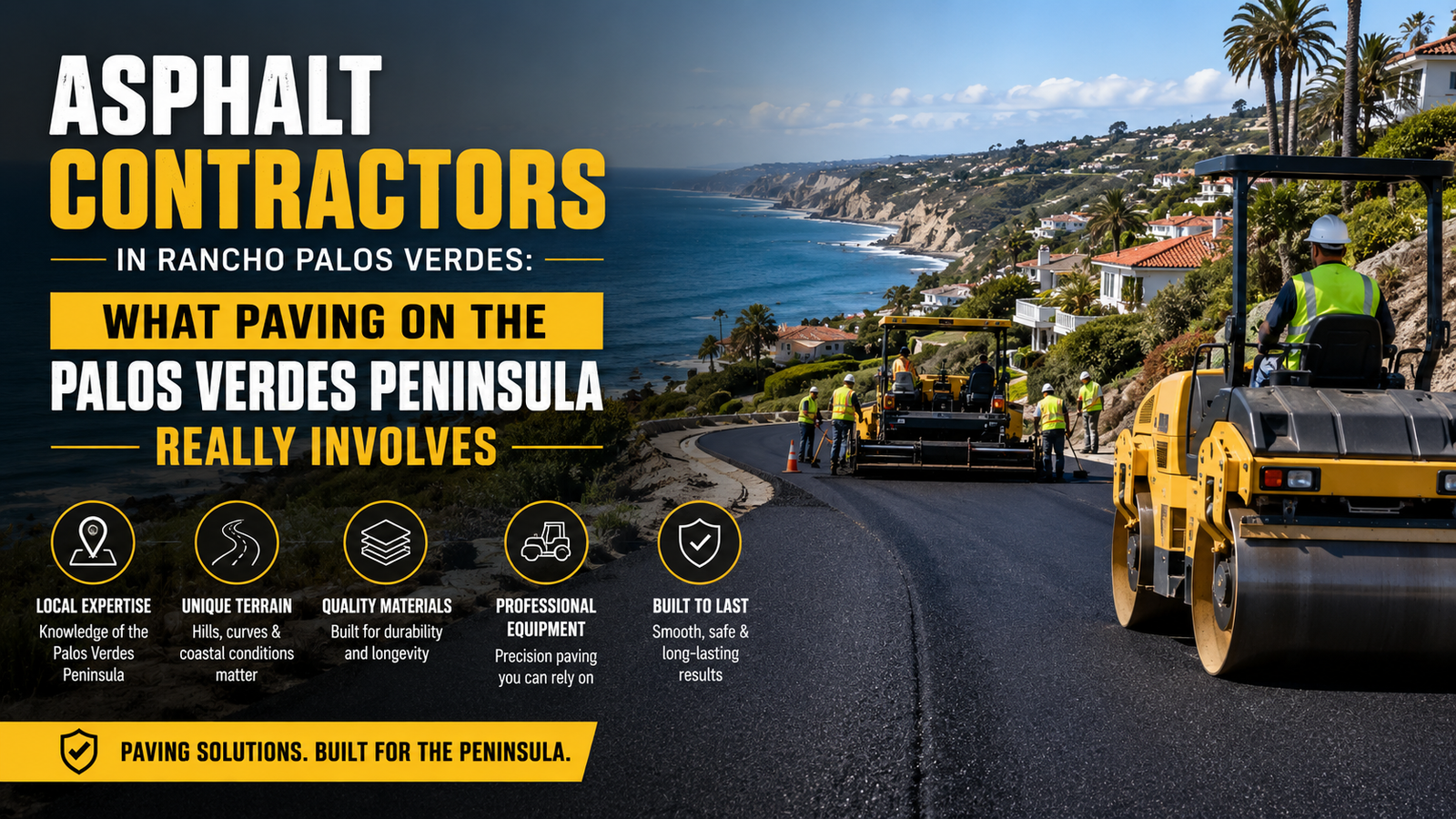
Rancho Palos Verdes is unlike almost any other community in Los Angeles County. Perched on the dramatic headlands of the Palos Verdes Peninsula, the city combines sweeping Pacific Ocean views, some of the highest residential property values in the county, and terrain that ranges from relatively flat mesa areas to steep coastal bluffs and hillside terrain with significant grade changes. This environment creates Asphalt Contractor Rancho Palos Verdes paving challenges that are meaningfully different from those encountered in the flat commercial corridors and residential tracts of the surrounding South Bay communities. For property owners, HOA managers, resort operators, and commercial facility teams throughout Rancho Palos Verdes, understanding what professional asphalt contractors provide and what makes paving on the Palos Verdes Peninsula distinctive is essential for making informed decisions about pavement installation and maintenance.
The Rancho Palos Verdes Environment and What It Does to Asphalt
Three environmental forces act on asphalt surfaces in Rancho Palos Verdes with unusual intensity: coastal salt air, hillside terrain with grade changes that affect drainage and loading, and the UV radiation characteristic of the Southern California coastal environment. Understanding how each of these forces affects asphalt performance explains why paving on the Palos Verdes Peninsula requires more specialized attention than paving in inland communities.
Salt air is the environmental factor most specific to Rancho Palos Verdes. Properties throughout the city particularly those west of Hawthorne Boulevard along Palos Verdes Drive South and the oceanfront estates and resort properties at Portuguese Bend, Lunada Bay, and the Terranea Resort area are exposed to marine air that carries chloride particles from the Pacific. These chloride particles attack the petroleum-based asphalt binder, accelerating its oxidation and making the surface brittle faster than in inland locations. The result is that asphalt surfaces near the ocean in Rancho Palos Verdes will fade from black to gray, develop surface cracking from binder oxidation, and begin to ravel (lose surface aggregate) more quickly than equivalent surfaces in communities without direct salt air exposure. Sealcoating which forms a protective barrier over the binder surface is proportionally more important in coastal communities like Rancho Palos Verdes than in inland locations.
Hillside terrain creates drainage challenges that require specific attention in pavement design. Rancho Palos Verdes’s dramatic topography means that many private roads, estate driveways, and paved areas experience significant grade changes. Water flowing down these grades can erode pavement edges, concentrate at low points, and in areas with inadequate drainage, saturate the pavement base and accelerate deterioration. Pavement installed on hillside terrain must be designed with drainage management in mind appropriate cross-slopes to direct water off the paved surface rather than allowing it to sheet across, properly designed drainage outlets at grade changes, and edge protection that prevents water from undercutting pavement edges on steep sections.
UV radiation on the Palos Verdes Peninsula is intense throughout the year. Southern California’s year-round sunshine means that asphalt binder oxidation driven primarily by UV exposure proceeds continuously without the winter-dormant period that gives asphalt in northern climates periodic respite. A Rancho Palos Verdes driveway or parking area that goes unsealed accumulates UV oxidation damage month over month, year over year, with no seasonal break. The Terranea Resort, the HOA-managed community roads of the various Palos Verdes neighborhoods, and the private estate driveways throughout the city all face this continuous UV challenge.
Residential Paving in Rancho Palos Verdes
Residential driveways in Rancho Palos Verdes range from short flat approaches serving homes on the more level mesa areas to extended hillside driveways serving the dramatic estate properties on the slopes. Both present specific paving challenges, and both benefit from the expertise of contractors familiar with Peninsula conditions.
Hillside driveways are among the most technically demanding residential paving projects in the South Bay. Steep grades require asphalt mix design attention a mix that performs well on flat terrain may rut or soften during summer heat on steep grades where vehicles make frequent braking and acceleration movements. Polymer-modified binders that maintain higher stiffness at elevated temperatures are the appropriate specification for steep hillside driveway applications in Rancho Palos Verdes. The surface texture must provide adequate traction for vehicles descending steep grades a broom finish or aggregate-exposed surface provides better grip than a smooth roller finish on steep residential driveways.
Drainage design on hillside driveways requires attention to how water flows when it reaches the bottom of a grade change. Water sheeting down a steep driveway at velocity can undercut the pavement edge at the base of the slope, erode adjacent landscaping, and create drainage problems for the garage area or the street below. Drainage aprons, catch basins positioned at grade breaks, and pervious borders alongside driveways can capture and redirect water that would otherwise concentrate and cause damage.
Sealcoating residential driveways in Rancho Palos Verdes at intervals of two to three years is the most impactful maintenance investment a homeowner can make. The combination of UV exposure, salt air, and the premium property values of the Peninsula all argue for consistent maintenance that preserves the driveway’s function and appearance. A well-maintained asphalt driveway on a Rancho Palos Verdes estate contributes to property value and presentation; an oxidized, cracked driveway is inconsistent with the community’s high property standards.
Commercial and HOA Paving in Rancho Palos Verdes
The commercial and HOA paving market in Rancho Palos Verdes is anchored by the Terranea Resort one of the South Bay’s premier luxury oceanfront destinations and by the network of HOA-managed community roads and facilities throughout the city’s various planned neighborhoods. The standards expected of paving work serving these clients are among the highest in Los Angeles County.
The Terranea Resort and surrounding hospitality properties require paving that combines structural durability with visual presentation appropriate for a premium guest experience. Guest arrival areas, parking facilities, service road access, and outdoor event areas all require pavement that is both functional and aesthetically consistent with the property’s luxury positioning. Paving contractors serving these properties must understand the specific operational requirements heavy event traffic concentrated in short windows, service vehicle access, valet operations that affect pavement design and maintenance scheduling.
HOA-managed community roads throughout Rancho Palos Verdes represent another significant paving category. Many of the city’s neighborhoods are served by private roads maintained by homeowners associations, and the condition of these roads directly affects property values and the experience of residents navigating their community. HOA boards in Rancho Palos Verdes engage paving contractors for long-term pavement management programs that systematically address road conditions throughout the community, prioritizing the most deteriorated sections within annual budget constraints while maintaining overall network condition.
ADA compliance is an active concern for all commercial properties and community facilities in Rancho Palos Verdes. California’s Title 24 accessibility standards require that parking facilities, pedestrian pathways, and building approach routes meet specific dimensional, slope, and surface condition standards for accessible use. Any paving project that modifies parking areas or pedestrian routes must incorporate ADA compliance review and any necessary improvements as part of the project scope.
Understanding Land Movement on the Palos Verdes Peninsula
No discussion of asphalt paving in Rancho Palos Verdes is complete without addressing the Peninsula’s unique geology. The Palos Verdes Peninsula is one of the most active areas of land movement in California a complex of landslide systems driven by the geology of the Altamira Shale and Palos Verdes Sand formations that underlie much of the city. The Abalone Cove Landslide, the Portuguese Bend Landslide, and numerous smaller slide systems are constantly active to varying degrees, and the land movement they generate can cause pavement cracking, settlement, and structural failure that is entirely unrelated to pavement design or construction quality.
Properties in active landslide zones within Rancho Palos Verdes require specific consideration before any paving investment is made. Paving over actively moving ground will replicate the damage regardless of how well it is installed the pavement surface simply follows the ground movement beneath it. Property owners in the Active Ancient Landslide (ALA) overlay zone designated by the City of Rancho Palos Verdes should understand the nature and rate of ground movement on their specific parcel before making significant paving investments. A paving contractor with Peninsula experience will identify landslide-related cracking patterns which typically follow linear paths associated with slide movement rather than the random patterns of typical asphalt deterioration and advise the property owner on the implications for repair durability.
Common Questions About Asphalt Contractors in Rancho Palos Verdes
How does salt air affect how often I should sealcoat my Rancho Palos Verdes property? Coastal salt air accelerates asphalt binder oxidation, making sealcoating proportionally more valuable in oceanfront communities. Properties within a few blocks of the water in Rancho Palos Verdes benefit from sealcoating every two years rather than the three-to-five-year interval appropriate for inland properties. Sealcoating protects the binder from both UV radiation and chloride exposure.
Are there specific asphalt mix requirements for steep driveways in Rancho Palos Verdes? Steep hillside driveways benefit from polymer-modified asphalt binders that resist rutting at high surface temperatures temperatures that are elevated on steep slopes by the combination of direct sun and the heat generated by braking vehicles. A coarser aggregate surface texture (broom finish or aggregate-exposed rather than smooth) provides better traction. Discuss your driveway’s grade with your contractor to confirm that the proposed mix design is appropriate for the slope and orientation of the specific driveway.
How do I know if cracking in my Rancho Palos Verdes pavement is from asphalt deterioration or land movement? Land movement cracking typically follows relatively straight lines that are consistent with the direction of ground movement on the property, and it often recurs after repair in the same location and orientation. Typical asphalt deterioration produces more random crack patterns. If you notice linear cracks that track with the slope direction of your property, or cracks that have recurred after previous repair, discussing the possibility of landslide-related movement with your contractor and potentially with a geotechnical engineer is advisable before investing in extensive repairs.